
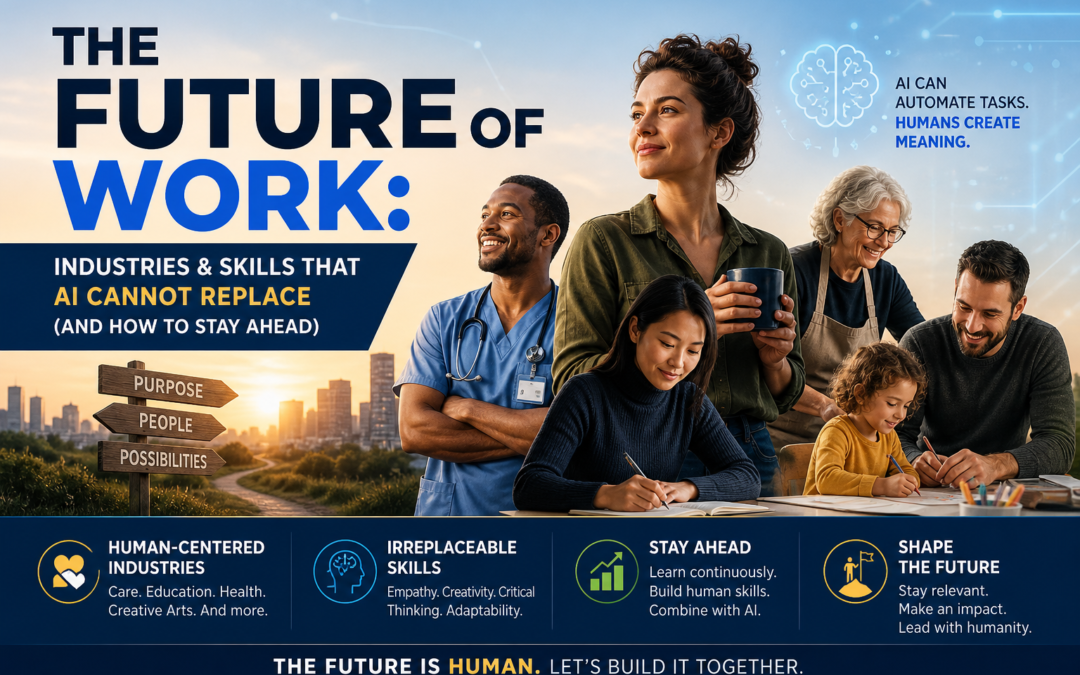
The Future of Work: Industries & Skills That AI Cannot Replace (And How to Stay Ahead)
📌 Key Insight
Artificial Intelligence is transforming industries at an unprecedented pace—but here’s the truth most people misunderstand: AI replaces tasks, not entire professions. The real winners in this new era are those who build careers around human strengths that technology cannot fully replicate—trust, creativity, leadership, and real-world execution.
If you want long-term relevance, income security, and authority, this guide will show you exactly where to focus.
🧠 Human-Centric Professions: The Power of Trust & Emotion
In a world flooded with automation, human connection becomes more valuable—not less.
Professionals in this category include:
- Psychologists and therapists
- Teachers (especially early childhood and special education)
- Coaches and mentors
- Social workers
- HR and culture leaders
These roles depend on empathy, emotional intelligence, and trust-building—areas where AI still falls short. While AI can simulate conversation, it cannot genuinely understand human pain, motivation, or personal transformation.
👉 Future Advantage: People will always seek real humans when it comes to life decisions, growth, and emotional support.
🏥 Healthcare & Caregiving: Where Precision Meets Humanity
Healthcare is one of the most AI-assisted—but not AI-replaced—industries.
Key roles:
- Doctors and surgeons
- Nurses and caregivers
- Physical therapists
- Emergency responders
These professions require hands-on care, real-time judgment, and ethical responsibility. AI can assist in diagnostics, but when lives are at stake, accountability must remain human.
👉 Future Advantage: The more critical the decision, the more valuable the human behind it.
🔧 Skilled Trades & Physical Work: The Real-World Advantage


In contrast to digital work, skilled trades operate in unpredictable, physical environments.
Examples include:
- Electricians
- Plumbers
- Carpenters
- Mechanics
- Construction professionals
- HVAC technicians
These jobs demand adaptability, physical skill, and problem-solving on-site—conditions that are extremely difficult to automate fully.
👉 Future Advantage: As automation grows, hands-on expertise becomes premium.
🎨 Creative & Strategic Fields: The Edge of Original Thinking


AI can generate content—but it cannot replace true originality, taste, and cultural relevance.
Key roles:
- Creative directors
- Brand strategists
- Film producers and directors
- High-level designers
- Entrepreneurs and innovators
Creativity at the highest level is not about producing content—it’s about creating meaning, direction, and emotional impact.
👉 Future Advantage: The more strategic and visionary your creativity is, the harder it is to replace.
⚖️ Leadership, Decision-Making & Governance
Leadership is not just about knowledge—it’s about responsibility and consequences.
Critical roles:
- CEOs and founders
- Government leaders and policymakers
- Judges and senior legal professionals
- Military strategists
These positions require ethical judgment, negotiation, and accountability—things AI cannot legally or morally assume.
👉 Future Advantage: Decision-makers will always outrank task-executors.
🛠️ Complex Problem Solvers & Innovators
AI is powerful in known systems—but weak in unknown, evolving problems.
High-value roles:
- Scientists and researchers
- Engineers (especially systems and AI engineers)
- Product innovators
- Crisis managers
These professionals operate in uncertainty, where experimentation, failure, and discovery are essential.
👉 Future Advantage: The more complex the problem, the more valuable the human solving it.
🤝 High-Touch Sales & Relationship Builders
In business, deals are not just data—they’re relationships.
Key roles:
- Enterprise sales professionals
- Business development leaders
- Negotiators and dealmakers
- Partnership managers
AI can analyze data, but it cannot replace trust, persuasion, and human chemistry.
👉 Future Advantage: Relationships will outperform algorithms in closing high-value deals.
🎭 Personal Brand & Performance-Based Careers
People don’t follow algorithms—they follow people.
Examples include:
- Influencers and content creators
- Public speakers
- Athletes
- Performers and entertainers
Even with AI-generated content, audiences gravitate toward authentic personalities and real human stories.
👉 Future Advantage: Your identity becomes your asset.
🧩 Hybrid Roles: The Smartest Career Move
The most future-proof professionals are not those avoiding AI—but those leveraging it.
Examples:
- AI strategists
- Automation architects
- SEO, AEO, and GEO specialists
- Data-driven decision makers
These roles position you as the controller of AI, not the competitor.
👉 Future Advantage: Those who direct AI will dominate those who ignore it.
⚠️ Reality Check: No Job Is 100% Safe
Let’s be clear—no industry is completely immune.
What will change:
- Tasks will be automated
- Entry-level roles may shrink
- Efficiency will increase
But here’s the upside:
👉 The top 10–20% performers in every field will become more valuable than ever.
🔑 Core Skills That AI Cannot Replace (Yet)
To stay ahead, master these:
- Critical thinking and judgment
- Emotional intelligence
- Leadership and influence
- Creativity and taste
- Adaptability and learning speed
- Ethical decision-making
- Complex problem-solving
- Communication and storytelling
These are not just “soft skills”—they are power skills in the AI era.
🚀 Final Thought: Don’t Compete With AI—Position Above It
The question is no longer:
❌ “What jobs will AI replace?”
The better question is:
✅ “How do I become irreplaceable in an AI-powered world?”
The Answer:
- Build human authority
- Develop decision-making power
- Combine AI tools with human intelligence
- Create trust, brand, and real-world value
💡 Closing Insight
AI will not eliminate opportunity—it will filter it.
Those who stay average may struggle.
Those who evolve will dominate.
👉 Your goal is not to survive AI—it’s to lead in the age of AI.
