
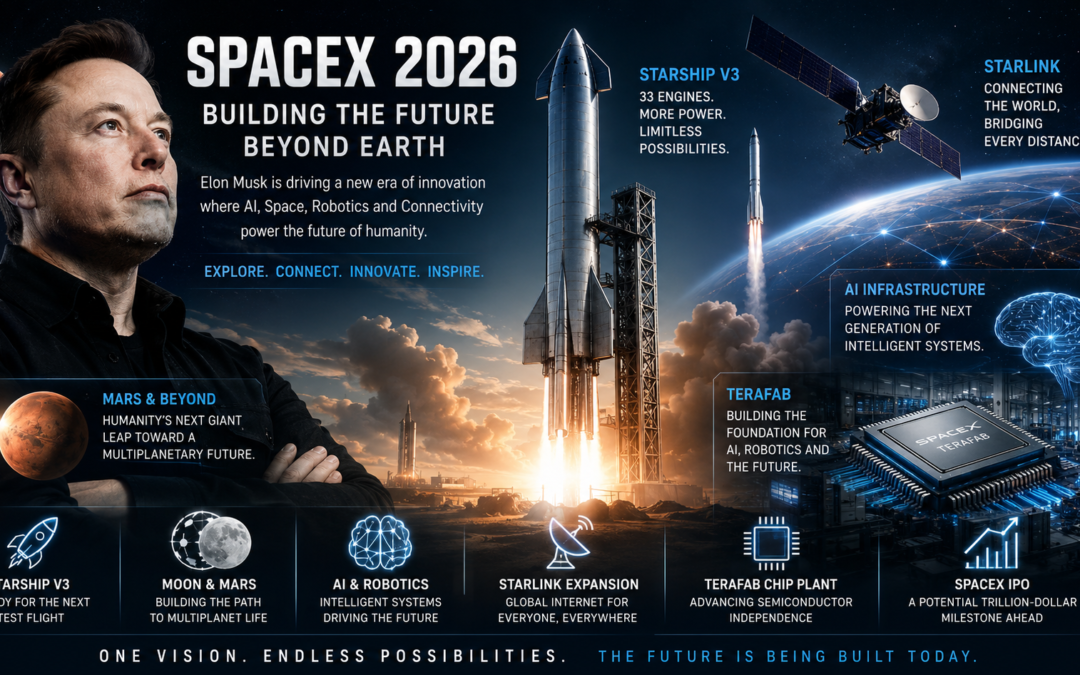
🚀 The SpaceX Revolution in 2026: How Elon Musk Is Reshaping AI, Space, Robotics & the Future of Humanity
by Roland Diaz | May 10, 2026 | AI, Elon Musk, SpaceX (Space Exploration Technologies Corp.
📌 Key Insights
- SpaceX successfully tested the powerful Starship V3 booster with 33 engines.
- Elon Musk continues pushing toward lunar and Mars exploration.
- SpaceX is expanding into AI infrastructure and semiconductor manufacturing.
- Starlink is becoming one of the largest global satellite internet systems.
- Analysts believe SpaceX may become one of the world’s most valuable companies.
- The company is now influencing aerospace, AI, robotics, defense, and communications industries globally.
Table of Contents
- The Rise of SpaceX Beyond Rockets
- Starship V3 and the Next Era of Space Travel
- Elon Musk’s Long-Term Mars Vision
- SpaceX and Artificial Intelligence Integration
- The Expansion of Starlink Worldwide
- Semiconductor Manufacturing and “Terafab”
- Why Investors Are Watching SpaceX Closely
- Global Impact on Technology and Business
- The Future of Human Civilization
- Key Takeaways
🌍 The Rise of SpaceX Beyond Rockets
For many years, SpaceX was primarily known as a private aerospace company focused on rocket launches and reusable spacecraft. However, 2026 marks a major transformation in the company’s global influence.
Today, SpaceX is rapidly evolving into a multi-industry technology powerhouse that combines:
- Artificial Intelligence
- Satellite Communications
- Robotics
- Semiconductor Manufacturing
- Space Infrastructure
- Autonomous Systems
- High-Performance Computing
Under the leadership of Elon Musk, the company is increasingly positioned as one of the most disruptive organizations in modern history.
What makes SpaceX unique is its ability to integrate multiple future-focused industries into one ecosystem. Rather than operating as separate technology divisions, SpaceX appears to be building a connected infrastructure designed for long-term planetary-scale operations.
This includes Earth-based AI systems, orbital communications, lunar logistics, and eventually interplanetary transportation.
The company’s growth reflects a broader global trend where the future of humanity may depend on organizations capable of combining software, hardware, energy, AI, and transportation into unified systems.
🚀 Starship V3 and the Next Era of Space Travel
One of the most important milestones in 2026 is the development of the new Starship V3 system.
SpaceX recently completed a successful 33-engine static fire test of the upgraded booster, representing a major advancement in reusable heavy-lift rocket engineering.
The Starship program is expected to support:
- NASA Artemis lunar missions
- Deep-space cargo transportation
- Orbital refueling operations
- Satellite deployments
- Future Mars exploration missions
The scale of Starship is unprecedented in commercial aerospace history.
Unlike traditional rockets that are used once and discarded, SpaceX continues refining reusable launch systems to dramatically reduce the cost of access to space.
This innovation could eventually make:
- Commercial lunar travel possible
- Space manufacturing economically viable
- Large-scale satellite systems more affordable
- Interplanetary logistics achievable
For governments, businesses, researchers, and future industries, the implications are enormous.
The success of reusable space transportation could create entirely new economic sectors that did not previously exist.
🌕 Elon Musk’s Long-Term Mars Vision
Although timelines continue evolving, Elon Musk remains strongly committed to long-term Mars colonization goals.
The company appears to be prioritizing:
- Lunar infrastructure
- Orbital fuel transfer systems
- Safety and reliability improvements
- Long-duration space travel technologies
Rather than rushing toward Mars immediately, SpaceX is focusing on building sustainable systems first.
This gradual strategy may ultimately improve mission success and reduce long-term operational risks.
Mars exploration is not simply about reaching another planet. It represents:
- Scientific advancement
- Human survival redundancy
- Technological innovation
- Global inspiration
- New economic possibilities
For many supporters, the Mars initiative symbolizes humanity’s ambition to become a multi-planetary civilization.
Even if full colonization takes decades, the technologies developed along the way are already influencing life on Earth.
🧠 SpaceX and Artificial Intelligence Integration
One of the most surprising developments in 2026 is SpaceX’s growing involvement in AI infrastructure.
The company is reportedly collaborating with advanced AI organizations while building massive high-performance computing systems.
This indicates that future space operations may rely heavily on:
- Autonomous robotics
- AI-assisted navigation
- Intelligent satellite systems
- Predictive engineering
- Automated manufacturing
AI is becoming essential for managing increasingly complex global systems.
SpaceX appears to recognize that future aerospace operations cannot rely solely on traditional human-controlled systems.
Instead, intelligent automation may become the backbone of:
- Deep-space missions
- Satellite optimization
- Space station logistics
- Autonomous spacecraft maintenance
- Planetary exploration robotics
This convergence between AI and aerospace could reshape both industries simultaneously.
📡 The Expansion of Starlink Worldwide
SpaceX continues rapidly expanding the Starlink network globally.
Starlink is now playing a critical role in:
- Remote internet connectivity
- Emergency communications
- Aviation internet systems
- Maritime connectivity
- Rural education access
- Disaster recovery support
For many developing regions, satellite internet could help bridge long-standing digital divides.
Reliable internet access increasingly affects:
- Education
- Healthcare
- Economic growth
- Remote work
- Global business participation
As more satellites enter orbit, SpaceX is strengthening its position as a major global telecommunications provider.
This could reshape how nations and businesses think about internet infrastructure in the future.
🏭 Semiconductor Manufacturing and “Terafab”
Reports surrounding the proposed “Terafab” semiconductor initiative have attracted major international attention.
The project could involve massive investments into:
- AI chip manufacturing
- Space-grade processors
- Autonomous systems hardware
- Advanced computing infrastructure
Semiconductors are now considered one of the world’s most strategically important technologies.
Modern industries depend heavily on chips for:
- AI systems
- Smartphones
- Vehicles
- Robotics
- Defense systems
- Medical devices
- Aerospace technology
If SpaceX successfully expands into semiconductor manufacturing, the company may gain even greater control over future technological ecosystems.
This could significantly influence global supply chains and advanced technology competition worldwide.
💰 Why Investors Are Watching SpaceX Closely
SpaceX continues attracting enormous investor interest due to its position across multiple high-growth industries.
Analysts see exposure to:
- AI infrastructure
- Space transportation
- Satellite communications
- Robotics
- Semiconductors
- Defense technologies
- Global internet systems
Some reports suggest a future SpaceX IPO could become one of the largest public offerings in history.
Although no final public timeline exists, global financial markets are closely monitoring developments.
The company’s valuation potential reflects increasing confidence in future technologies connected to:
- AI economies
- Space economies
- Automation
- Global connectivity
- Infrastructure modernization
🌐 Global Impact on Technology and Business
The rise of SpaceX is influencing global industries far beyond aerospace.
Businesses worldwide are paying closer attention to:
- AI adoption
- Automation readiness
- Infrastructure modernization
- Satellite communications
- Robotics integration
- High-speed connectivity
The broader message is clear:
Future companies must become more technologically adaptive and globally connected.
Organizations that fail to innovate may struggle in increasingly AI-driven economies.
Meanwhile, businesses capable of integrating:
- AI
- Digital transformation
- automation
- advanced communications
- scalable infrastructure
may gain significant long-term advantages.
🚀 The Future of Human Civilization
Whether people support or criticize Elon Musk’s methods, few can deny the scale of SpaceX’s influence on the future.
The company’s projects now touch:
- Transportation
- Communications
- AI
- Robotics
- Energy
- Aerospace
- Defense
- Manufacturing
This convergence of technologies may help define the next century of human civilization.
SpaceX represents more than rockets.
It represents a global experiment in accelerating technological progress at unprecedented speed.
The coming decade may determine whether humanity successfully enters a new era of:
- planetary connectivity
- intelligent automation
- advanced exploration
- sustainable innovation
- multi-planetary expansion
📌 Key Takeaways
- SpaceX is rapidly evolving beyond traditional aerospace.
- Starship V3 marks a major milestone in reusable rocket technology.
- AI integration is becoming central to future space operations.
- Starlink continues expanding global internet accessibility.
- Semiconductor manufacturing may become a new SpaceX frontier.
- Elon Musk’s Mars vision remains a long-term strategic objective.
- SpaceX could become one of the most influential technology ecosystems in the world.
Trusted Resources & References
- SpaceX Official Website
- Starlink Official Website
- NASA Artemis Program
- Reuters Technology News
- Space.com Space Exploration News
#SpaceX #ElonMusk #Starship #Starlink #ArtificialIntelligence #MarsMission #FutureTechnology #SpaceExploration #AIInfrastructure #Innovation2026

