

🌍 Key Insight
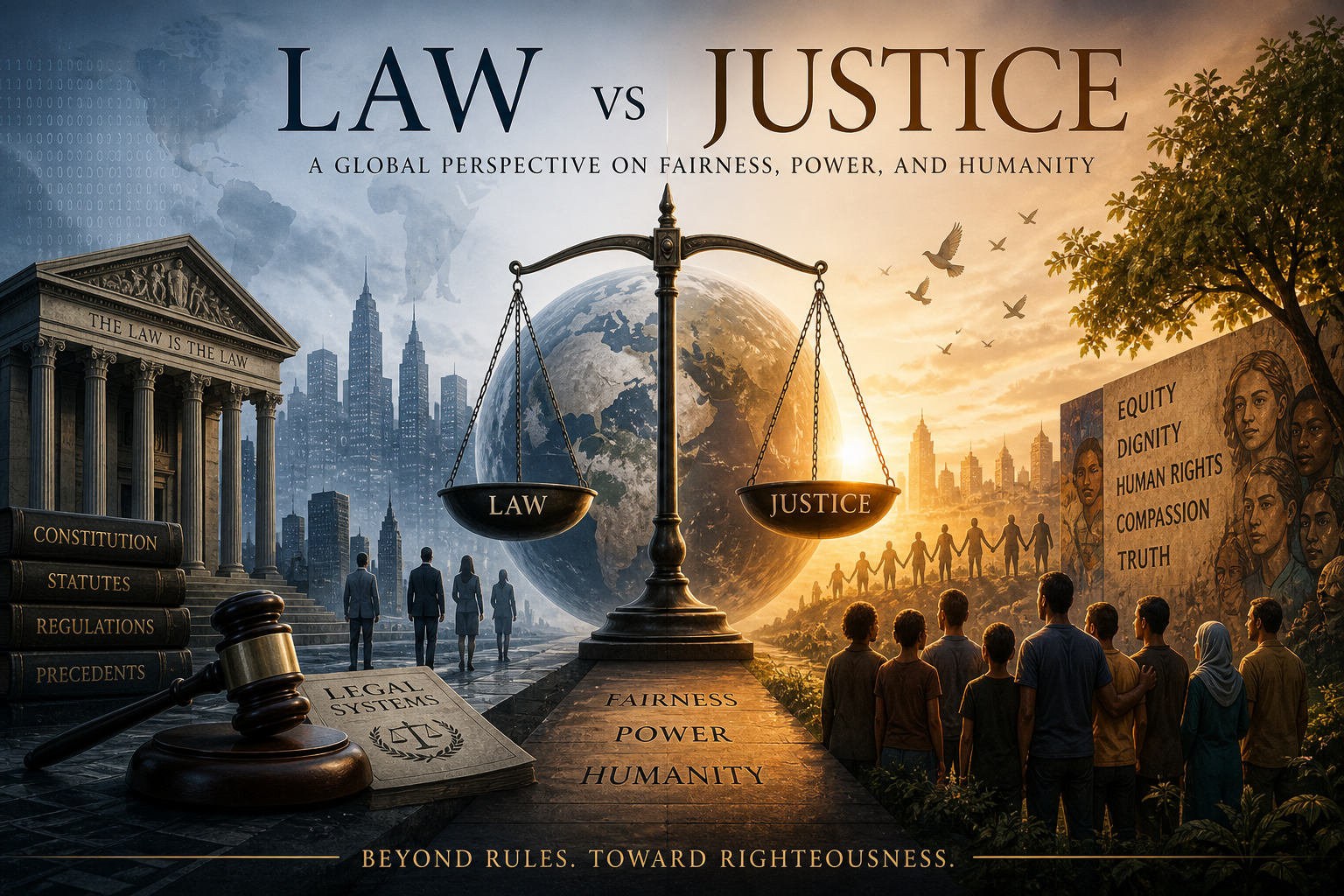
Across the world, every country has laws—but not every system delivers justice equally. Law is created by governments. Justice is judged by humanity. Understanding the difference is essential in a global society where cultures, beliefs, and systems collide.
⚖️ What Is Law in a Global Context?
Law is a formal system of rules recognized and enforced by institutions—courts, governments, and international bodies. While every country has its own legal framework, the purpose is similar: maintain order, protect rights, and resolve conflicts.
🌐 Global Characteristics of Law:
- Defined by national governments (civil law, common law, religious law systems)
- Enforced by courts and authorities
- Supported by international agreements and treaties
- Varies significantly across countries
📍 Example:
A business contract in the United States may follow common law principles, while in France, it follows civil law. In some countries, religious law may influence legal decisions.
👉 Law is structured—but not universal in application.
🧭 What Is Justice Across Cultures?
Justice goes beyond written rules. It reflects values, ethics, and what people believe is fair. Unlike law, justice is not limited by borders—it evolves with society.
🌎 Global Characteristics of Justice:
- Influenced by culture, religion, and philosophy
- Focuses on fairness, equality, and human dignity
- Can challenge unjust laws
- Drives reform and social change
📍 Example:
A law may be legal in one country but viewed as unjust globally—especially when it violates human rights.
👉 Justice is universal in principle—but diverse in interpretation.
⚔️ When Law and Justice Clash Worldwide


Throughout history, many laws have been legal—but not just.
🌍 Global Examples of Conflict:
- Laws that allowed racial or social discrimination
- Restrictions on freedom of speech or expression
- Unequal access to legal protection or fair trials
- Laws that protect power instead of people
👉 These conflicts often spark global movements for reform, human rights advocacy, and systemic change.
🏛️ The Role of Global Institutions
To bridge the gap between law and justice, international organizations work toward shared standards.
🌐 Key Global Bodies:
- United Nations – Promotes human rights, peace, and global cooperation
- International Court of Justice – Resolves disputes between nations
- International Criminal Court – Prosecutes crimes like genocide and war crimes
👉 These institutions aim to create justice beyond borders, though enforcement can be complex.
⚖️ Why Law ≠ Justice (Globally)
Even with global frameworks, gaps still exist:
1. Cultural Differences
What is “just” varies across societies.
2. Political Influence
Laws can be shaped by those in power.
3. Economic Inequality
Access to justice often depends on resources.
4. Legal Systems Lag Behind Change
Technology, AI, and globalization evolve faster than laws.
👉 Justice is aspirational. Law is operational.
🌍 The Ideal World: Aligning Law and Justice
A fair global system works toward alignment between legal systems and moral values.
This requires:
- Strong human rights protections
- Transparent and accountable governments
- Equal access to legal systems
- Continuous reform and global cooperation
📍 Example:
Global agreements on human rights aim to ensure that laws protect dignity regardless of nationality.
🧠 Your Role in a Global Society
Justice is no longer local—it’s global. Every individual has influence.
You contribute when you:
- Stay informed about global issues
- Respect laws while questioning injustice
- Support fairness in your community and online
- Use your voice responsibly in a connected world
👉 In the digital age, awareness can drive global change.
🔥 The Balance That Defines Civilization
- Law without justice leads to oppression
- Justice without law leads to disorder
The goal is balance—where systems are structured yet humane, and rules are enforced with fairness.
💬 Final Thought
“Justice is what gives law its meaning. Without it, law is just control.”
In a globalized world, the challenge is not just creating laws—but ensuring they reflect humanity’s highest values.
📌 Key Takeaways
- Law is structured and enforced; justice is moral and evolving
- Legal systems vary globally; justice principles aim to be universal
- Conflicts between law and justice drive reform
- Global institutions attempt to bridge the gap
- Every individual plays a role in shaping a more just world